
How many currency pairs should you follow at once?
A question that comes up again and again in training: how many currency pairs can you watch effectively? The answer: it depends on your personality, and on the…
Read more
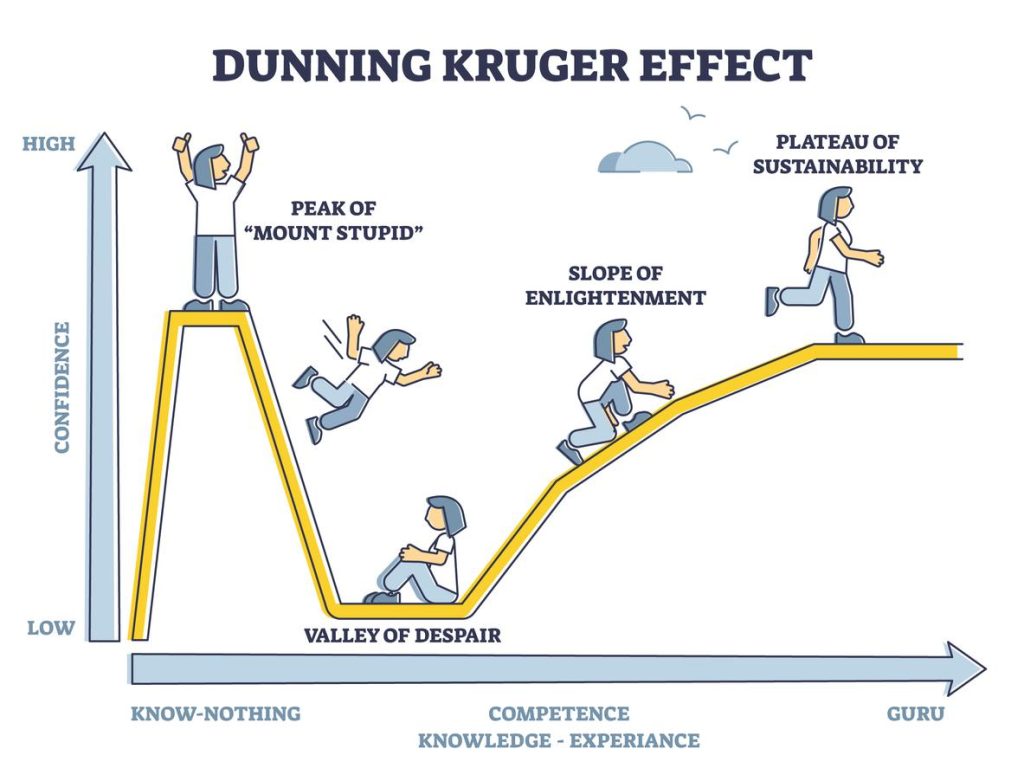
There is a meme I like very much, because it is cuttingly honest: people stand on a conveyor belt, pass through a gate marked Facebook, and come out the other side as university professors handing out wisdom. That, in essence, is the Dunning-Kruger effect. It is the tragic case of the fool being clever, as opposed to the clever person being foolish, with which there is nothing wrong at all.
David Dunning and Justin Kruger, researchers at Cornell University, first published their results in 1999, and they came as a serious shock to many. They summed up their theory in four points:
On social media you often see this theory confirmed among the wildly judgemental, harshly critical commenters who never ask questions, because they are completely certain that they understand everything perfectly. They are unmoved by the fact that someone is a professional who has worked in the field for 20+ years, read tens of thousands of studies and run thousands of experiments - as far as they are concerned that person still does not know the subject, end of story!
Mel Gibson said to Larry King in a 1997 interview: “I wish the critics would make films too! Then we would have perfect films to learn a lot from.” Why do those bloody-mouthed critics not take the trouble to shoot the benchmarks of the profession?
You can criticise and lecture very vehemently, filled with the illusion of knowledge - as long as you stay at the level of talk.
The moment we step out of that, set a goal and work to achieve it, it becomes very quickly clear how much we actually know. Minimal knowledge makes the almost incomprehensibly complicated look terribly simple. A good example is quantum physics, which so many people cite, seeing in it the proof of the creative power of thought, when they would not understand a single sentence of a textbook on the subject.
More articles
A question that comes up again and again in training: how many currency pairs can you watch effectively? The answer: it depends on your personality, and on the…
Read moreLife sometimes forces us to decide quickly - quickly and well. What is the secret of good decisions made fast? The procedure.
Read moreTo understand how a trader can consistently make good decisions, we have to understand the mechanism of decision-making itself. The basis of a good decision is data.
Read more